About

Showing posts with label NASA. Show all posts

Hubble Images of Asteroids Vesta and Ceres

These Hubble Space Telescope images of Vesta and Ceres show two of the most massive asteroids in the asteroid belt, a region between Mars and Jupiter. The images are helping astronomers plan for the Dawn spacecraft’s tour of these hefty asteroids.

On July 7, NASA is scheduled to launch the spacecraft on a four-year journey to the asteroid belt. Once there, Dawn will do some asteroid-hopping, going into orbit around Vesta in 2011 and Ceres in 2015. Dawn will be the first spacecraft to orbit two targets. At least 100,000 asteroids inhabit the asteroid belt, a reservoir of leftover material from the formation of our solar-system planets 4.6 billion years ago.

Dawn also will be the first satellite to tour a dwarf planet. The International Astronomical Union named Ceres one of three dwarf planets in 2006. Ceres is round like planets in our solar system, but it does not clear debris out of its orbit as our planets do.

To prepare for the Dawn spacecraft’s visit to Vesta, astronomers used Hubble’s Wide Field Planetary Camera 2 to snap new images of the asteroid. The image at right was taken on May 14 and 16, 2007. Using Hubble, astronomers mapped Vesta’s southern hemisphere, a region dominated by a giant impact crater formed by a collision billions of years ago. The crater is 285 miles (456 kilometers) across, which is nearly equal to Vesta's 330-mile (530-kilometer) diameter. If Earth had a crater of proportional size, it would fill the Pacific Ocean basin. The impact broke off chunks of rock, producing more than 50 smaller asteroids that astronomers have nicknamed “vestoids.” The collision also may have blasted through Vesta’s crust. Vesta is about the size of Arizona.

Hubble’s view reveals extensive global features stretching longitudinally from the northern hemisphere to the southern hemisphere. The image also shows widespread differences in brightness in the east and west, which probably reflect compositional changes. Both of these characteristics could reveal volcanic activity throughout Vesta. The size of these different regions varies. Some are hundreds of miles across.

The brightness differences could be similar to the effect seen on the Moon, where smooth, dark regions are more iron-rich than the brighter highlands that contain minerals richer in calcium and aluminum. When Vesta was forming 4.5 billion years ago, it was heated to the melting temperatures of rock. This heating allowed heavier material to sink to Vesta’s center and lighter minerals to rise to the surface.

Astronomers combined images of Vesta in two colors to study the variations in iron-bearing minerals. From these minerals, they hope to learn more about Vesta’s surface structure and composition. Astronomers expect that Dawn will provide rich details about the asteroid’s surface and interior structure.

The Hubble image of Ceres on the left reveals bright and dark regions on the asteroid’s surface that could be topographic features, such as craters and/or areas containing different surface material. Large impacts may have caused some of these features and potentially added new material to the landscape. The Texas-sized asteroid holds about 30 to 40 percent of the mass in the asteroid belt. Ceres’ round shape suggests that its interior is layered like those of terrestrial planets such as Earth. The asteroid may have a rocky inner core, an icy mantle and a thin, dusty outer crust. The asteroid may even have water locked beneath its surface. It is approximately 590 miles (950 kilometers) across and was the first asteroid discovered in 1801.

The observations were made in visible and ultraviolet light between December 2003 and January 2004 with the Advanced Camera for Surveys. The color variations in the image show either a difference in texture or composition on Ceres’ surface. Astronomers need the close-up views of the Dawn spacecraft to determine the characteristics of these regional differences.

The Hubble Space Telescope is a project of international cooperation between NASA and the European Space Agency. The Space Telescope Science Institute conducts Hubble science operations. The institute is operated for NASA by the Association of Universities for Research in Astronomy, Inc., Washington.

Credits for Vesta: NASA; ESA; L. McFadden and J.Y. Li (University of Maryland, College Park); M. Mutchler and Z. Levay (Space Telescope Science Institute, Baltimore); P. Thomas (Cornell University); J. Parker and E.F. Young (Southwest Research Institute); and C.T. Russell and B. Schmidt (University of California, Los Angeles).

Credits for Ceres: NASA; ESA; J. Parker (Southwest Research Institute); P. Thomas (Cornell University); L. McFadden (University of Maryland, College Park); and M. Mutchler and Z. Levay (Space Telescope Science Institute).

Source: NASA

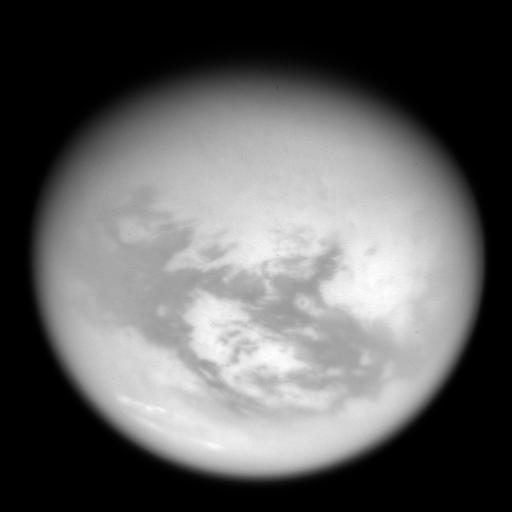
Weather Without Water

Bright mid-latitude clouds near the bottom of this view hint at the ongoing cycling of methane on Titan. These cloud streaks are near the same latitude as similar clouds observed above different longitudes on Titan.

The view is centered on Titan's trailing hemisphere, over the 1,700 kilometer (1,050 mile) wide bright region known as Adiri. North on Titan (5,150 kilometers, or 3,200 miles across) is up and rotated 15 degrees to the right.

This view was created by combining multiple images taken using a combination of spectral filters sensitive to wavelengths of infrared light centered at 939 and 742 nanometers.

The images were taken with the Cassini spacecraft wide-angle camera on May 13, 2007 at a distance of approximately 104,000 kilometers (65,000 miles) from Titan. Image scale is 12 kilometers (8 miles) per pixel. Due to scattering of light by Titan's hazy atmosphere, the sizes of surface features that can be resolved are a few times larger than the actual pixel scale.

Credit: NASA/JPL/Space Science Institute

Source: JPL

New Science on the Moon

NASA has selected proposals, including two from the Jet Propulsion Laboratory in Pasadena, Calif., for future lunar science activities. In addition, the agency has established two new programs that will enhance research made possible by the Vision for Space Exploration.

The proposals and programs are part of an effort by NASA to develop new opportunities to conduct important science investigations during the planned renewal of human exploration of the moon.

The seven selected proposals will result in advanced development for simple, autonomous instrument packages deployed on the lunar surface by astronauts. Such "suitcase science" packages could open up a wide variety of research applications regarding the moon and the lunar environment.

Some of the funded efforts will help scientists better understand the lunar dust that creates problems for astronauts on the moon. Other studies will provide a better understanding of the moon's interior, look for natural resources on the lunar surface and use lasers to provide precise information about the position of the moon and its features.

"The proposals we received show that the scientific community is excited about the opportunity to capitalize on the nation's planned lunar outpost. The moon has much to teach us about itself, the history of our solar system, and even the history of the sun. In the future, more and more scientists will be able to participate in lunar research as we focus attention on Earth's fascinating satellite," said Alan Stern, associate administrator for NASA's Science Mission Directorate.

The two selected proposals from JPL are:

"Autonomous Lunar Geophysical Experiment Package"--William Banerdt, principal investigator".

"Lunar Laser Transponder and Retroreflector Science"--Slava Turyshev, principal investigator".

The other selected proposals are:

Goddard Space Flight Center, Greenbelt, Md., "Volatile Analysis by Pyrolysis of Regolith on the Moon using Mass Spectrometry"-- Daniel Glavin, principal investigator.

Goddard Space Flight Center, "Seismology and Heat flow instrument package for Lunar Science and Hazards"-- Patrick Taylor, principal investigator.

Southwest Research Institute, Boulder, Colo., "Lunar Radiation Environment and Regolith Shielding Experiment"-- Donald Hassler, principal investigator.

U.S. Army Engineer Research and Development Center, Fort Wainwright, Alaska, "Lunar Suitcase Science: A Lunar Regolith Characterization Kit" --Jerome Johnson, principal investigator.

Ball Aerospace and Technologies Corp., Boulder, Colo., "Autonomous Lunar Dust Observer" -- Christian Grund, principal investigator.

Under the planned Lunar Advanced Science and Exploration Research program, proposals will be solicited for investigations to increase knowledge of the moon while also providing necessary information for humans to live and work there. Studies may include simulations and laboratory work to better understand the lunar environment and its hazards, such as dust and radiation. The program also will support analysis of existing lunar data, including the Apollo and robotic mission data archives, and work to understand the origin and evolution of the moon.

In the upcoming Lunar Reconnaissance Orbiter Participating Scientist Program, NASA will select researchers to perform detailed investigations using instruments aboard the spacecraft during its first years in lunar orbit. Proposals for both programs are due Sept. 7, 2007.

Lunar Reconnaissance Orbiter is NASA's next orbital mission to the moon. Launch is planned in late 2008. It will orbit the moon for at least one year, providing data to accelerate opportunities for future science missions and human exploration.

More information: http://www.nasa.gov/exploration

Image credit: USGS

Source: NASA

Crews to Fold Arrays, Prep for Spacewalk Repair Tasks

As Space Shuttle Atlantis and the International Space Station sail above Earth today, the STS-117 and Expedition 15 crews will continue retracting solar arrays and preparing for repair work during Friday’s spacewalk.

STS-117 Mission Specialists Jim Reilly and Danny Olivas will review procedures and practice techniques they will use during the spacewalk set to begin at 1:38 p.m. EDT Friday. The first task of the extravehicular activity is the repair of a thermal blanket that pulled away from the orbital maneuvering system pod on the rear of the shuttle.

This afternoon, the STS-117 crew will resume retraction of the starboard P6 solar array. Almost half of the 31½ array bays were retracted Wednesday. If the arrays are not fully retracted today, efforts will resume Friday with the assistance of the spacewalkers.

About an hour and 20 minutes before this morning’s scheduled wakeup call, the crews were awakened by a false alarm on the station. The alarm was triggered by the restart of Russian navigation computers that provide backup attitude control and orbital altitude adjustments. For now, the station’s control moment gyroscopes are handling attitude control, with the shuttle’s propulsion system providing backup.

Credit: NASA

Source: NASA

STS-117 Crew Inspected Shuttle Heat Shield

The STS-117 crew members completed the day's scheduled inspections of Space Shuttle Atlantis’ heat shield. They used Atlantis’ robotic arm and an attached boom extension to check the spacecraft’s underside, nose cap and leading edges of the wings as well as hard to reach shuttle surfaces.

The inspections are performed to check if any damage occurred to the heat shield during the climb to orbit that began when Atlantis lifted off Friday from Kennedy Space Center, Fla. Over the next few days, engineers and flight controllers will analyze the data collected by the STS-117 crew.

Last night during the robot arm checkout, the robotic arm cameras were used to take a closer look at an area of insulation blanket on the port orbital maneuvering system pod that pulled away from adjacent thermal tiles. Engineers are analyzing the imagery

Throughout the day, the crew has been preparing for Sunday’s arrival at the International Space Station. The day's activities include the extension of the shuttle’s docking ring and the check out of tools they will use to rendezvous and link up with the station. Docking is set for 3:38 p.m. Sunday.

Earlier today, the STS-117 crew checked out spacesuits to be used during the mission’s three scheduled spacewalks at the space station. The major objective of the spacewalks is to install and activate the station’s newest component, the Starboard 3 and 4 (S3/S4) truss segments, and to assist in the retraction of the starboard array on the Port 6 truss.

STS-117 is also delivering a new crew member to the station.

Credit: NASA TV

Source: NASA

Titan

Despite centuries of speculation and decades of research, scientists are still seeking fundamental clues to the question of how life began on Earth. Titan [TIE-tun] is the frozen vault that may contain these secrets for the Cassini-Huygens mission to discover.

Titan is the largest of Saturn's moons, bigger than the planets Mercury and Pluto. The study of Titan is one of the major goals of the Cassini-Huygens mission because it may preserve, in deep-freeze, many of the chemical compounds that preceded life on Earth.

Long hidden behind a thick veil of haze, Titan is the only moon in the solar system that possesses a dense atmosphere (10 times denser than Earth's). The fact that this atmosphere is rich in organic material and that living organisms as we know them are composed of organic material is particularly intriguing. "Organic" means only that the material is carbon-based, and does not necessarily imply any connection to living organisms.

The story of Titan is gradually unfolding. Titan is a dynamic place with complex geologic processes. The lack of many craters indicates that Titan's surface may be relatively young, because Earth-like processes of tectonics, erosion, winds, and perhaps volcanism, shape its surface. Though hazy, Titan's atmosphere is relatively cloud-free.

Cassini will execute 45 flybys of Titan, some of them only several hundred kilometers from its surface. The European Space Agency's Huygens probe, which pierced Titan's thick-dense haze, was dedicated to the study of Titan's atmosphere. The probe actually survived for several hours on the surface and returned stunning images.

Credit: NASA/JPL/Space Science Institute

Source: NASA

NASA Updates Shuttle Target Launch Date for Hubble Mission

NASA managers officially are targeting Sept. 10, 2008, for the launch of the fifth and final space shuttle servicing mission to the Hubble Space Telescope. During the 11-day flight, Atlantis' seven astronauts will repair and improve the observatory's capabilities through 2013.

Mission planners have been working since last fall, when the flight was announced, to determine the best time in the shuttle manifest to support the needs of Hubble while minimizing the impact to International Space Station assembly. NASA also will support a "launch on need" flight during the Hubble mission. In the unlikely event a rescue flight becomes necessary, shuttle Endeavour currently is planned to lift off from Launch Pad 39-B at NASA's Kennedy Space Center, Fla. However, managers constantly are evaluating the manifest to determine the best mission options.

Shuttle missions beyond the Hubble flight still are being assessed. Shuttle and station program officials will continue to consider options for the remainder of the shuttle flights to complete construction of the space station by 2010, when the fleet will be retired. Those target launch dates are subject to change.

The Hubble Space Telescope is an international cooperative project between NASA and the European Space Agency. For more information about Hubble, visit: Hubble

Source: NASA

STS 117 Mission

At today's Launch Readiness News Conference, the Mission Management Team announced that they were in agreement that Space Shuttle Atlantis is ready to fly on Friday.

"The team is ready to go and we're just really excited to be at this point after a very long and arduous spring and a lot of really hard work by the entire team," said LeRoy Cain, launch integration manager for the Space Shuttle Program. "I'm very proud of the team."

NASA Launch Director Mike Leinbach reported that the countdown is going fine and there no significant issues to report.

The forecast for launch day, according to U.S. Air Force Lt. Col. Pat Barrett, weather officer from the 45th squadron, remains at a 30-percent chance of violating launch constraints. A high-pressure ridge is expected to move to the north which could help clear out any thunderstorm activity over Kennedy Space Center.

At 10:30 p.m. EDT Thursday, the protective rotating service structure will be rolled away from the space shuttle. External tank fuel loading is scheduled to begin at around 9:30 a.m. EDT Friday.

The launch countdown for Atlantis officially began at 9 p.m. EDT Tuesday, at T-43 hours. Included in the countdown is nearly 28 hours of built-in hold time prior to a targeted 7:38 p.m. EDT launch on Friday.

credit: NASA/Troy Cryder

Source: NASA

MESSENGER spacecraft approaches the brightly illuminated Venus on June 5

In the coming evenings, sky watchers can acquaint themselves with the MESSENGER spacecraft mission to Mercury. Late afternoon on Tuesday, June 5, 2007, MESSENGER will fly within about 210 miles (340 kilometers) of the surface of the planet Venus, and get a gravity kick toward its ultimate destination, the sun-baked planet Mercury.

Both Venus and Mercury will be well-placed for viewing during dusk the week before MESSENGER's encounter with Venus. Go to a location away from bright lights with a good view of the western and northwestern horizon. Venus is the brilliant "evening star" fairly high above the western horizon. Forty-five minutes after sunset (or between 8:45 p.m. and 9:45 p.m. Daylight Time, depending on your location within your time zone), you should start to see other bright stars and planets as the sky darkens.

Credit: NASA/JHUAPL

Source: NASA

New view of Titan

Today, two and a half years after the historic landing of ESA’s Huygens probe on Titan, a new set of results on Saturn’s largest moon is ready to be presented. Titan, as seen through the eyes of Huygens still holds exciting surprises, scientists say.

On 14 January 2005, after a seven-year voyage on board the NASA/ESA/ASI Cassini spacecraft, ESA’s Huygens probe spent 2 hours and 28 minutes descending by parachute to land on Titan. It then sent transmissions from the surface for another seventy minutes before Cassini moved out of range.

On 8 December that year, a combined force of scientists published their preliminary findings in Nature. Now, after another year and a half of patient work, they are ready to add fresh details to their picture of Titan. This time, the papers are published in a special issue of the Planetary and Space Science magazine.

“The added value comes from computer modelling,” says Jonathan Lunine, Huygens Interdisciplinary Scientist from the Lunar and Planetary Laboratory, University of Arizona.

By driving their computer models of Titan to match the data returned from the probe, planetary scientists can now visualise Titan as a working world. “Even though we have only four hours of data, it is so rich that after two years of work we have yet to retrieve all the information it contains,” says François Raulin, Huygens Interdisciplinary Scientist, at the Laboratoire de Physique et Chimie de l'Environnement, Paris.

The new details add greatly to the picture of Saturn’s largest moon. “Titan is a world very similar to the Earth in many respects,” says Jean-Pierre Lebreton, ESA Huygens Project Scientist.Huygens found that the atmosphere was hazier than expected because of the presence of dust particles – called ‘aerosols’. Now, scientists are learning how to interpret their analysis of these aerosols, thanks to a special chamber that simulates Titan’s atmosphere.

When the probe dropped below 40 kilometres in altitude, the haze cleared and the cameras were able to take their first distinct images of the surface. They revealed an extraordinary landscape showing strong evidence that a liquid, possibly methane, has flowed on the surface, causing erosion. Now, images from Cassini are being coupled with the ‘ground truth’ from Huygens to investigate how conditions on Titan carved out this landscape.

Credits: ESA/NASA/JPL/University of Arizona

Source: ESA

Neon Saturn

Flying over the unlit side of Saturn's rings, the Cassini spacecraft captures Saturn's glow, represented in brilliant shades of electric blue, sapphire and mint green, while the planet's shadow casts a wide net on the rings.

This striking false-color mosaic was created from 25 images taken by Cassini's visual and infrared mapping spectrometer over a period of 13 hours, and captures Saturn in nighttime and daytime conditions. The visual and infrared mapping spectrometer acquires data simultaneously at 352 different wavelengths, or spectral channels. Data at wavelengths of 2.3, 3.0 and 5.1 microns were combined in the blue, green and red channels of a standard color image, respectively, to make this false-color mosaic.

This image was acquired on Feb. 24, 2007, while the spacecraft was 1.58 million kilometres (1 million miles) from the planet and 34.6 degrees above the ring plane. The solar phase angle was 69.5 degrees. In this view, Cassini was looking down on the northern, unlit side of the rings, which are rendered visible by sunlight filtering through from the sunlit, southern face.

On the night side (right side of image), with no sunlight, Saturn's own thermal radiation lights things up. This light at 5.1 microns wavelength (some seven times the longest wavelength visible to the human eye) is generated deep within Saturn, and works its way upward, eventually escaping into space. Thick clouds deep in the atmosphere block that light. An amazing array of dark streaks, spots, and globe-encircling bands is visible instead. Saturn's strong thermal glow at 5.1 microns even allows these deep clouds to be seen on portions of the dayside (left side), especially where overlying hazes are thin and the glint of the sun off of them is minimal. These deep clouds are likely made of ammonium hydrosulphide and cannot be seen in reflected light on the dayside, since the glint of the sun on overlying hazes and ammonia clouds blocks the view of this level.

A pronounced difference in the brightness between the northern and southern hemispheres is apparent. The northern hemisphere is about twice as bright as the southern hemisphere. This is because high-level, fine particles are about half as prevalent in the northern hemisphere as in the south. These particles block Saturn's glow more strongly, making Saturn look brighter in the north.

At 2.3 microns (shown in blue), the icy ring particles are highly reflecting, while methane gas in Saturn's atmosphere strongly absorbs sunlight and renders the planet very dark. At 3.0 microns (shown in green), the situation is reversed: water ice in the rings is strongly absorbing, while the planet's sunlit hemisphere is bright. Thus the rings appear blue in this representation, while the sunlit side of Saturn is greenish-yellow in color. Within the rings, the most opaque parts appear dark, while the more translucent regions are brighter. In particular, the opaque, normally-bright B ring appears here as a broad, dark band separating the brighter A (outer) and C (inner) rings

At 5.1 microns (shown in red), reflected sunlight is weak and thus light from the planet is dominated by thermal (i.e., heat) radiation that wells up from the planet's deep atmosphere. This thermal emission dominates Saturn's dark side as well as the north polar region (where the hexagon is again visible) and the shadow cast by the A and B rings. Variable amounts of clouds in the planet's upper atmosphere block the thermal radiation, leading to a speckled and banded appearance, which is ever-shifting due to the planet's strong winds.

The Cassini-Huygens mission is a cooperative project of NASA, the European Space Agency and the Italian Space Agency. The Jet Propulsion Laboratory, a division of the California Institute of Technology in Pasadena, manages the mission for NASA's Science Mission Directorate, Washington, D.C. The Cassini obiter was designed, developed and assembled at JPL. The Visual and Infrared Mapping Spectrometer team is based at the University of Arizona, where this image was produced.

Credit: NASA/JPL/University of Arizona

Source: NASA

Research Finds That Earth's Climate is Approaching Dangerous Point

NASA and Columbia University Earth Institute research finds that human-made greenhouse gases have brought the Earth’s climate close to critical tipping points, with potentially dangerous consequences for the planet.

Image above: Antarctica lost much more ice to the sea than it gained from snowfall according to a NASA survey done between 1992 and 2002. It also had a corresponding rise in sea level. The survey documented for the first time extensive thinning of the West Antarctic ice shelves.

From a combination of climate models, satellite data, and paleoclimate records the scientists conclude that the West Antarctic ice sheet, Arctic ice cover, and regions providing fresh water sources and species habitat are under threat from continued global warming. The research appears in the current issue of Atmospheric Chemistry and Physics.

Credit: NASA/SVS

Source: NASA

 
Astronomy © 2012 | Designed by Rumah Dijual, in collaboration with Buy Dofollow Links! =) , Lastminutes and Ambien Side Effects