About

Showing posts with label nebula. Show all posts

Pillars of Creation

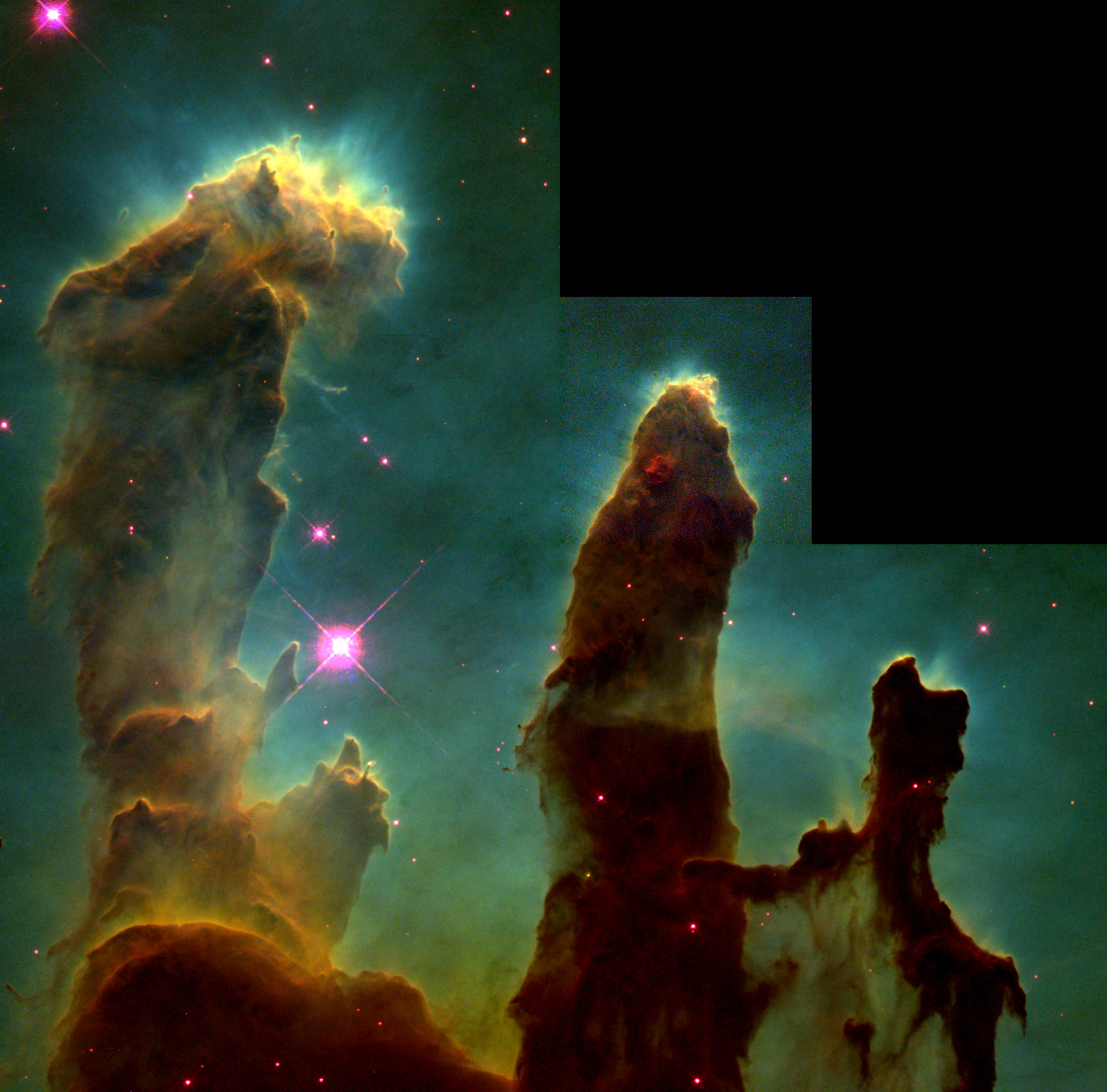
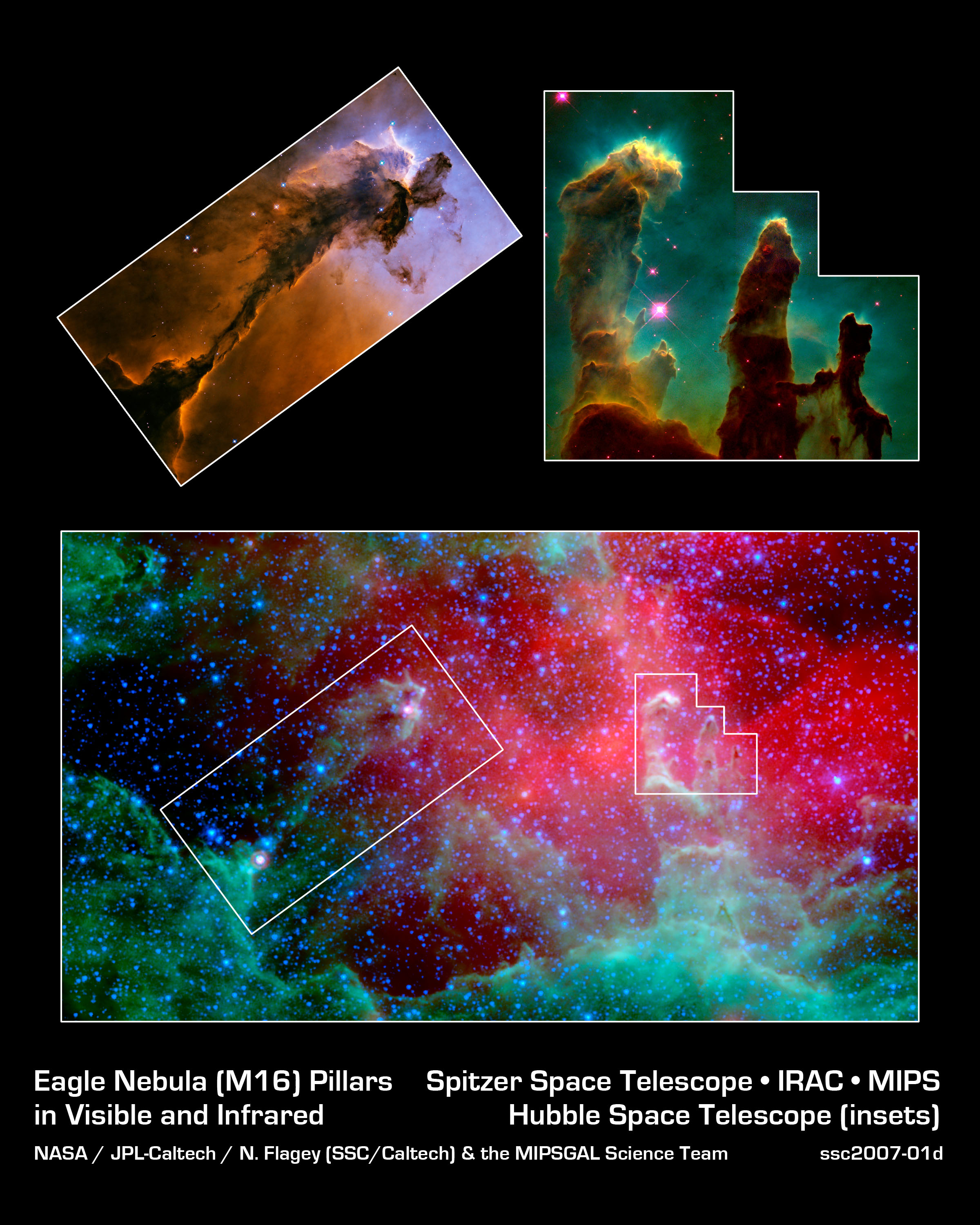
This image composite highlights the pillars of the Eagle nebula, as seen in infrared light by NASA's Spitzer Space Telescope (bottom) and visible light by NASA's Hubble Space Telescope (top insets).

The top right inset focuses on the three famous pillars, dubbed the "Pillars of Creation," which were photographed by Hubble in 1995. Hubble's optical view shows the dusty towers in exquisite detail, while Spitzer's infrared eyes penetrate through the thick dust, revealing ghostly transparent structures. The same effect can be seen for the pillar outlined in the top left box.

In both cases, Spitzer's view exposes newborn stars that were hidden inside the cocoon-like pillars, invisible to Hubble. These stars were first uncovered by the European Space Agency's Infrared Satellite Observatory. In the Spitzer image, two embedded stars are visible at the tip and the base of the left pillar, while one star can be seen at the tip of the tallest pillar on the right.

Image Credit: NASA/JPL-Caltech/STScI/ Institut d'Astrophysique Spatiale

Source: NASA

Rosset nebula

This infrared image from NASA's Spitzer Space Telescope shows the Rosette nebula, a pretty star-forming region more than 5,000 light-years away in the constellation Monoceros. In optical light, the nebula looks like a rosebud, or the "rosette" adornments that date back to antiquity.

But lurking inside this delicate cosmic rosebud are so-called planetary "danger zones" (see spheres illustrations in figure 1). These zones surround super hot stars, called O-stars (blue stars inside spheres), which give off intense winds and radiation. Young, cooler stars that just happen to reside within one of these zones are in danger of having their dusty planet-forming materials stripped away.

While O-star danger zones were known about before, their parameters were not. Astronomers used Spitzer's infrared vision to survey the extent of the five danger zones shown here. The results showed that young stars lying beyond 1.6 light-years, or 10 trillion miles, of any O-stars are safe, while young stars within this zone are likely to have their potential planets blasted into space.

Radiation and winds from the super hot stars have collectively blown layers of dust (green) and gas away, revealing the cavity of cooler dust (red). The largest two blue stars in this picture are in the foreground, and not in the nebula itself.

This image shows infrared light captured by Spitzer's infrared array camera. Light with wavelengths of 24 microns is red; light of 8 microns is green; and light of 4.5 microns is blue.

Image Credit: NASA/JPL-Caltech/Univ. of Ariz

Source: NASA

 
Astronomy © 2012 | Designed by Rumah Dijual, in collaboration with Buy Dofollow Links! =) , Lastminutes and Ambien Side Effects