About

Showing posts with label Titan. Show all posts

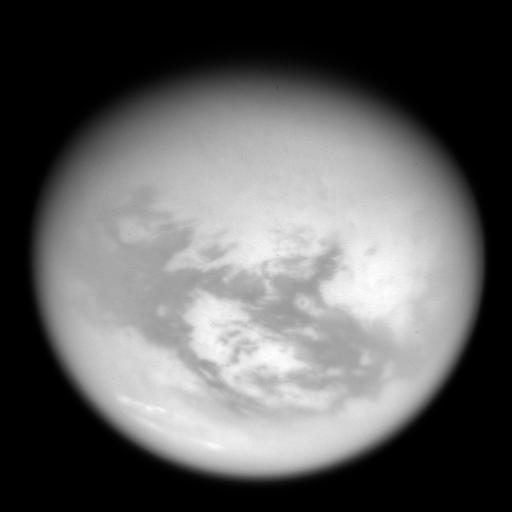
Weather Without Water

Bright mid-latitude clouds near the bottom of this view hint at the ongoing cycling of methane on Titan. These cloud streaks are near the same latitude as similar clouds observed above different longitudes on Titan.

The view is centered on Titan's trailing hemisphere, over the 1,700 kilometer (1,050 mile) wide bright region known as Adiri. North on Titan (5,150 kilometers, or 3,200 miles across) is up and rotated 15 degrees to the right.

This view was created by combining multiple images taken using a combination of spectral filters sensitive to wavelengths of infrared light centered at 939 and 742 nanometers.

The images were taken with the Cassini spacecraft wide-angle camera on May 13, 2007 at a distance of approximately 104,000 kilometers (65,000 miles) from Titan. Image scale is 12 kilometers (8 miles) per pixel. Due to scattering of light by Titan's hazy atmosphere, the sizes of surface features that can be resolved are a few times larger than the actual pixel scale.

Credit: NASA/JPL/Space Science Institute

Source: JPL

New View of Titan III

This image of Titan's surface, obtained by Huygens' DISR imager, shows patterns of tectonic and fluid-flow activity. The tectonic patterns are indicated by blue lines; the drainage divide is indicated by the red line; flow directions are indicated by the green arrows. The Huygens landing site is marked by a white cross.

Credits: ESA/NASA/JPL/University of Arizona


Source: NASA

New View of Titan II

This composite of Huygens DISR images shows patterns of drainage, flow and erosion in the Huygens landing site region.

The top panel shows two types of drainage networks in the bright region about 5-10 kilometres north of the landing site. The lower-left panel is a high-resolution view of the erosional channels around the landing site. The lower right panel is a medium-resolution view of bright ridges standing above the dark plains carved by surface flows.

Credits: ESA/NASA/JPL/University of Arizona

Source: NASA

Titan

Despite centuries of speculation and decades of research, scientists are still seeking fundamental clues to the question of how life began on Earth. Titan [TIE-tun] is the frozen vault that may contain these secrets for the Cassini-Huygens mission to discover.

Titan is the largest of Saturn's moons, bigger than the planets Mercury and Pluto. The study of Titan is one of the major goals of the Cassini-Huygens mission because it may preserve, in deep-freeze, many of the chemical compounds that preceded life on Earth.

Long hidden behind a thick veil of haze, Titan is the only moon in the solar system that possesses a dense atmosphere (10 times denser than Earth's). The fact that this atmosphere is rich in organic material and that living organisms as we know them are composed of organic material is particularly intriguing. "Organic" means only that the material is carbon-based, and does not necessarily imply any connection to living organisms.

The story of Titan is gradually unfolding. Titan is a dynamic place with complex geologic processes. The lack of many craters indicates that Titan's surface may be relatively young, because Earth-like processes of tectonics, erosion, winds, and perhaps volcanism, shape its surface. Though hazy, Titan's atmosphere is relatively cloud-free.

Cassini will execute 45 flybys of Titan, some of them only several hundred kilometers from its surface. The European Space Agency's Huygens probe, which pierced Titan's thick-dense haze, was dedicated to the study of Titan's atmosphere. The probe actually survived for several hours on the surface and returned stunning images.

Credit: NASA/JPL/Space Science Institute

Source: NASA

New view of Titan

Today, two and a half years after the historic landing of ESA’s Huygens probe on Titan, a new set of results on Saturn’s largest moon is ready to be presented. Titan, as seen through the eyes of Huygens still holds exciting surprises, scientists say.

On 14 January 2005, after a seven-year voyage on board the NASA/ESA/ASI Cassini spacecraft, ESA’s Huygens probe spent 2 hours and 28 minutes descending by parachute to land on Titan. It then sent transmissions from the surface for another seventy minutes before Cassini moved out of range.

On 8 December that year, a combined force of scientists published their preliminary findings in Nature. Now, after another year and a half of patient work, they are ready to add fresh details to their picture of Titan. This time, the papers are published in a special issue of the Planetary and Space Science magazine.

“The added value comes from computer modelling,” says Jonathan Lunine, Huygens Interdisciplinary Scientist from the Lunar and Planetary Laboratory, University of Arizona.

By driving their computer models of Titan to match the data returned from the probe, planetary scientists can now visualise Titan as a working world. “Even though we have only four hours of data, it is so rich that after two years of work we have yet to retrieve all the information it contains,” says François Raulin, Huygens Interdisciplinary Scientist, at the Laboratoire de Physique et Chimie de l'Environnement, Paris.

The new details add greatly to the picture of Saturn’s largest moon. “Titan is a world very similar to the Earth in many respects,” says Jean-Pierre Lebreton, ESA Huygens Project Scientist.Huygens found that the atmosphere was hazier than expected because of the presence of dust particles – called ‘aerosols’. Now, scientists are learning how to interpret their analysis of these aerosols, thanks to a special chamber that simulates Titan’s atmosphere.

When the probe dropped below 40 kilometres in altitude, the haze cleared and the cameras were able to take their first distinct images of the surface. They revealed an extraordinary landscape showing strong evidence that a liquid, possibly methane, has flowed on the surface, causing erosion. Now, images from Cassini are being coupled with the ‘ground truth’ from Huygens to investigate how conditions on Titan carved out this landscape.

Credits: ESA/NASA/JPL/University of Arizona

Source: ESA

 
Astronomy © 2012 | Designed by Rumah Dijual, in collaboration with Buy Dofollow Links! =) , Lastminutes and Ambien Side Effects